



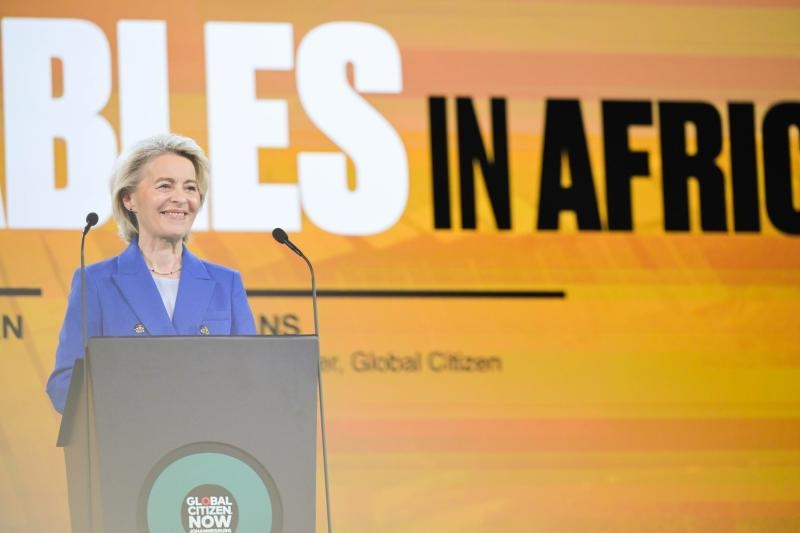
The European Commission (EC) announced today the successful mobilisation of €15.5bn investment for Africa’s renewable energy sector, following a year-long international campaign jointly led by the commission’s president Ursula von der Leyen and South African President Cyril Ramaphosa, with support from the advocacy group Global Citizen and the International Energy Agency.
Brussels accounted for more than €15.1bn of the total, including about €10bn pledged by Ms von der Leyen on behalf of “Team Europe,” a coalition of EU institutions, member states, and development finance bodies. Additional contributions came from European governments and financial institutions, alongside private-sector investment.
The campaign aims to speed up Africa’s clean energy transition, improve electricity access, and support long-term economic growth powered by renewable sources. The funding is expected to help generate 26.8 gigawatts of new renewable power and bring electricity to 17.5 million households that currently live in darkness.
“Today, the world has stepped up for Africa,” Ms von der Leyen said. “With €15.5bn, we are turbocharging Africa’s clean-energy transition. This investment is a surge of opportunity: thriving markets, new jobs and reliable, clean energy.”
Team Europe package includes new global gateway projects backed by countries such as Germany, France, Denmark, Italy, the Netherlands and Spain, as well as major contributions from the European Investment Bank (€2.1bn) and the European Bank for Reconstruction and Development (€740m). Several EU member states also announced bilateral commitments worth more than €5bn.
Beyond Europe, the African Development Bank committed to channel at least 20% of the next replenishment of its African Development Fund towards renewable energy, while Norway pledged €53m to the fund for the 2026–2028 period.
Africa’s energy needs remain urgent, with around 600 million people still lacking access to electricity. Despite possessing 60% of the world’s best solar resources, the continent attracts less than 3% of global energy investment, hindered by high financing costs and infrastructure constraints.
The campaign, launched in Rio de Janeiro in November 2024, was designed to help close this gap and build momentum behind global efforts to triple renewable energy capacity and double energy efficiency by 2030, targets agreed at the COP28 climate summit.
According to the EU, these new commitments align with its global gateway strategy and the Africa-Europe green energy initiative, which focus on renewable energy generation, transmission infrastructure and cross-border power trade. Several European actors have also indicated plans to further increase renewable energy investments by 2030, potentially adding another €4bn to the sector.