



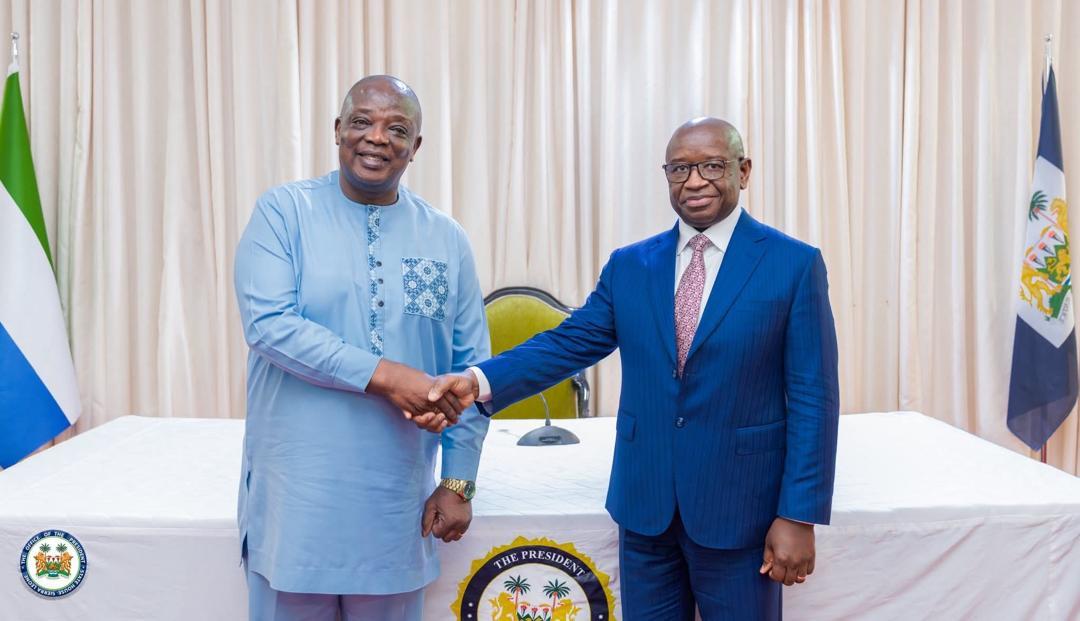
The main opposition All Peoples Congress (APC) announced the formal withdrawal of its elected officials from all governance structures nationwide on Tuesday, following the swearing-in of Edmond Sylvester Alpha as chief electoral commissioner of the Electoral Commission for Sierra Leone (ECSL).
The APC accused the SLPP-led government of reneging on key commitments under the Agreement for National Unity and undermining the credibility of electoral reforms agreed through the Tripartite Committee process.
The government, on the other hand, has refuted the claims, citing the president’s constitutional authority to appoint the electoral commissioner. They argue that neither the Agreement for National Unity nor the Tripartite Committee report supersedes the 1991 Constitution. Therefore, the appointment of Edmond Sylvester Alpha is valid, having satisfied the constitutional provisions requiring consultation and parliamentary approval.
In a meeting convened by the Independent Commission for Peace and National Cohesion (ICPNC) this week, with the APC leadership, the Attorney General and Minister of Justice, representatives of ECOWAS, and other international development partners in attendance, the APC argued that Mr. Alpha’s appointment runs contrary to the “spirit, intent and sequencing” of the Tripartite Committee recommendations, which were crafted following the disputed 2023 general elections. The party maintains that placing a figure it describes as closely associated with the contested polls at the helm of the electoral body erodes public confidence and jeopardizes future elections.
“The appointment gravely undermines public confidence in the Electoral Commission and threatens the credibility of future elections,” the APC said.
As a result, the party says it has withdrawn its members of parliament and local council representatives from governance activities across the country until Mr. Alpha vacates the position.
It could be recalled that an Agreement for National Unity was reached between the APC and the SLPP-led government following weeks of political deadlock over disagreement with the 2023 polls. Brokered by the ECOWAS and other international partners under the aegis of the Peace Commission, the Agreement for National Unity culminated in the formation of a Tripartite Committee tasked with examining electoral irregularities and recommending reforms.
Observers say the current standoff signals a breakdown in trust between the opposition and the government at a critical stage of a reform process already fraught with accusations and counter accusations from a political standpoint, with serious implications for legislative business, oversight functions, and service delivery. Political analysts warn that prolonged disengagement may deepen polarization and stall the reform momentum.
“The risk here is institutional paralysis,” said governance expert Michael Kargbo. “If key stakeholders retreat from formal governance spaces, reform becomes harder, not easier.”
The government now accuses the APC of selfishly putting partisan interest above the nation’s interest whilst the APC contends that its decision is not partisan but grounded in a commitment to constitutional governance and electoral integrity.
The APC says it remains open to re-engagement once “meaningful steps” are taken to restore confidence in the electoral reform process.